Systems Audit & Optimization
Systems Audit &
Optimization
Operational architecture and systems mapping
PROBLEM
The bottleneck: Before scaling the team, my workflow lived too much in my head. It was intuitive, undocumented, and impossible to hand off. To grow, I needed to turn it from something only I could run into a replicable system that didn't depend on my constant involvement.
APPROACH
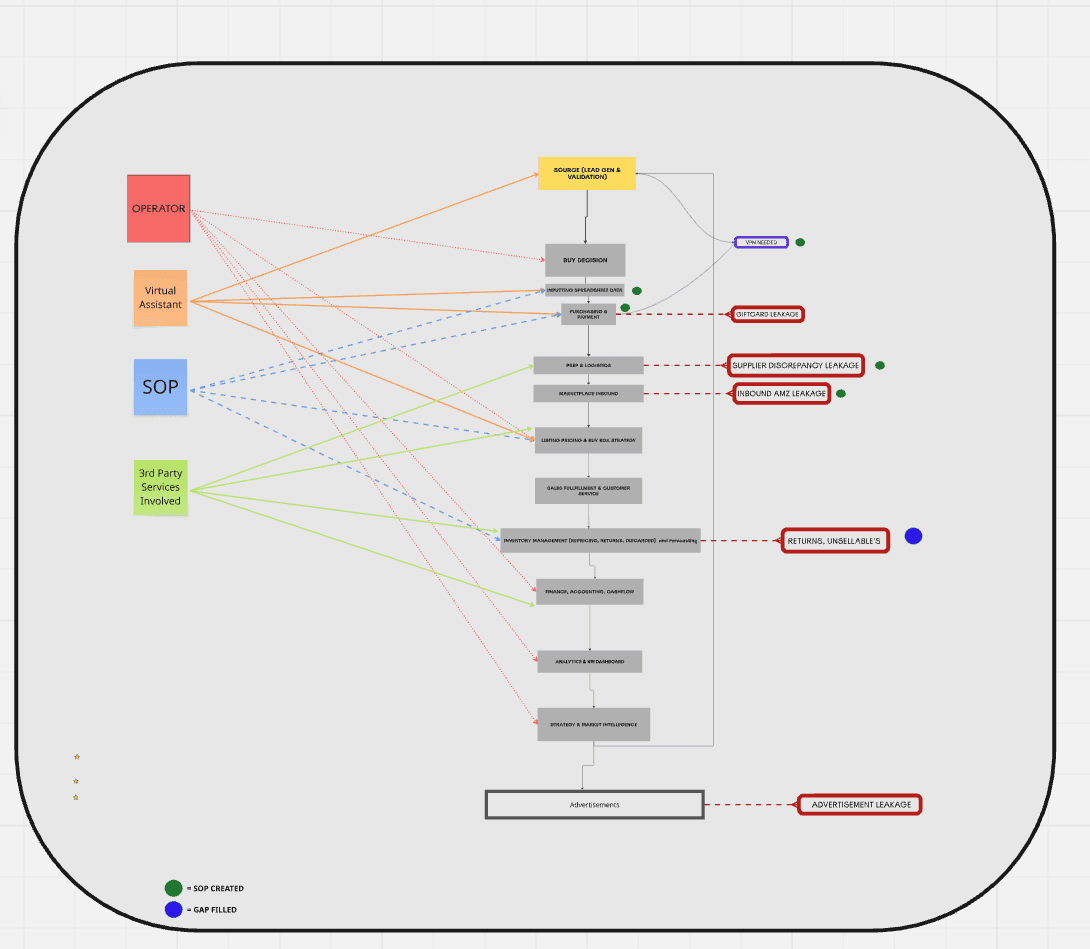
The method: an input/output audit. I audited the entire business lifecycle, from lead generation to cashflow, treating the operation as a programmable system of inputs and outputs.
Process mapping. I visualized the critical path of the business, separating high-leverage tasks like strategy and buying from repeatable tasks like data entry and logistics, so labor could be allocated where it actually mattered.
Standardization. I built a playbook of standard operating procedures for every repeatable dependency, turning subjective judgment calls into objective, rule-based workflows the team could follow.
The key finding: revenue leakage. The most important result was isolating four specific points where profit was quietly eroding from process inefficiencies. I set up protocols to plug each one:
Supplier discrepancies. Reconciliation audits to recover capital from missing vendor inventory.
Inbound logistics. Tracking systems to identify and claim units lost during Amazon FBA intake.
Ad spend efficiency. Tighter audit cycles to cut wasted spend on underperforming campaigns.
Dead stock recovery. A structured liquidation process to extract remaining capital from returns and unsellable items.
OUTCOME
Recovered revenue. Plugging the four leakage points directly improved net margins by stopping invisible waste.
Operational readiness. The SOP playbook let me onboard people into a structured environment, cutting training time and removing decision fatigue.
Strategic clarity. The project shifted how I saw the business, from a series of daily tasks to a system. Once I understood which inputs (like sourcing quality) drove which outputs (like revenue), I could stop working the business and start tuning it.