Sourcing Pay Redesign
Fixing a money-losing incentive structure
PROBLEM
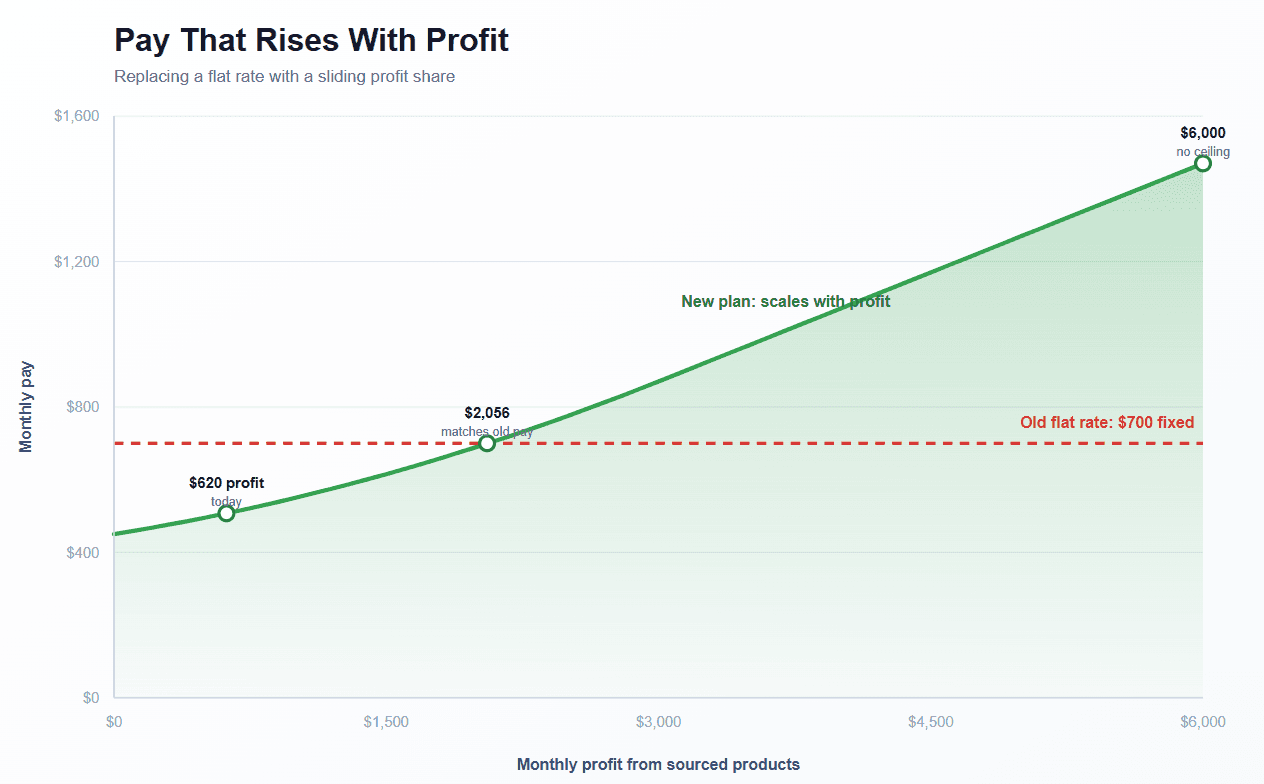
Effort and reward were locked at 1:1. In my online arbitrage operation, sourcing (finding products worth buying) was handled by a VA on a flat $700 a month. The pay was fixed regardless of output, so a great month and a mediocre month earned exactly the same. There was no pull toward producing more, because producing more didn't pay more. At the time the products that sourcer found were generating about $620 a month in net profit after Amazon fees, returns, and cost of goods. The structure was linear and flat, and I needed it to be nonlinear, where stronger output earns disproportionately more.
It was also a textbook principal-agent problem: the flat rate rewarded volume over quality, so the sourcer did exactly what it asked for, lots of mediocre products. Realized margin was running about 6.7% against the 12% I sourced to, most of the gap tracing to a 9% refund rate that nothing in the pay structure made the sourcer care about.
APPROACH
Base plus profit share, on a sliding scale. I replaced the flat rate with a base plus a profit share built so my cost can never outrun the value created. The share starts at 8% and climbs continuously to 20% as monthly profit reaches $3,000, then holds the rate there. Each additional dollar of profit earns a slightly higher rate than the one before, so weak months stay cheap and strong months pay the sourcer disproportionately more.
The hardest constraint was timing. A sourced product takes about three months to fully resolve before its true profit is known. So payout is calculated on a fully settled number from three months back, each work month matched to its payout month. To avoid a cliff during the transition, I added a declining top-up for the first three months ($250, $150, $75), structured as padding the sourcer keeps, not a loan.
Made the math transparent. I built it into a calculator that takes one input, a month's profit, and outputs the exact payout using the sliding-scale integral. Alongside it I rewrote the sourcing criteria to favor products with real depth over one-off flips, and added category-level margin floors on the items driving refunds.
Why this over simpler options. A per-lead bounty just moves the gaming to "volume of approved leads." A clean 50% share ignored that I carry all the capital risk. And a continuous scale beats fixed tiers, which create plateaus where a sourcer at $2,900 earns the same marginal rate as one at $1,500, dulling the incentive exactly where it should be sharpest.
OUTCOME
Live and rolling out across all my sourcers, the same logic scaled to each.
Flips sourcing to roughly break-even at current output, and gives a strong sourcer a path to earn well above the old flat rate as their profit climbs.
It turns pay into a filter: find profitable, repeatable products and you earn more; can't, and the cost to the business scales down automatically. Either outcome is the right one.
PROBLEM
Effort and reward were locked at 1:1. In my online arbitrage operation, sourcing (finding products worth buying) was handled by a VA on a flat $700 a month. The pay was fixed regardless of output, so a great month and a mediocre month earned exactly the same. There was no pull toward producing more, because producing more didn't pay more. At the time the products that sourcer found were generating about $620 a month in net profit after Amazon fees, returns, and cost of goods. The structure was linear and flat, and I needed it to be nonlinear, where stronger output earns disproportionately more.
It was also a textbook principal-agent problem: the flat rate rewarded volume over quality, so the sourcer did exactly what it asked for, lots of mediocre products. Realized margin was running about 6.7% against the 12% I sourced to, most of the gap tracing to a 9% refund rate that nothing in the pay structure made the sourcer care about.
APPROACH
Base plus profit share, on a sliding scale. I replaced the flat rate with a base plus a profit share built so my cost can never outrun the value created. The share starts at 8% and climbs continuously to 20% as monthly profit reaches $3,000, then holds the rate there. Each additional dollar of profit earns a slightly higher rate than the one before, so weak months stay cheap and strong months pay the sourcer disproportionately more.
The hardest constraint was timing. A sourced product takes about three months to fully resolve before its true profit is known. So payout is calculated on a fully settled number from three months back, each work month matched to its payout month. To avoid a cliff during the transition, I added a declining top-up for the first three months ($250, $150, $75), structured as padding the sourcer keeps, not a loan.
Made the math transparent. I built it into a calculator that takes one input, a month's profit, and outputs the exact payout using the sliding-scale integral. Alongside it I rewrote the sourcing criteria to favor products with real depth over one-off flips, and added category-level margin floors on the items driving refunds.
Why this over simpler options. A per-lead bounty just moves the gaming to "volume of approved leads." A clean 50% share ignored that I carry all the capital risk. And a continuous scale beats fixed tiers, which create plateaus where a sourcer at $2,900 earns the same marginal rate as one at $1,500, dulling the incentive exactly where it should be sharpest.
OUTCOME
Live and rolling out across all my sourcers, the same logic scaled to each.
Flips sourcing to roughly break-even at current output, and gives a strong sourcer a path to earn well above the old flat rate as their profit climbs.
It turns pay into a filter: find profitable, repeatable products and you earn more; can't, and the cost to the business scales down automatically. Either outcome is the right one.